Shopping Cart

In contemporary interior architecture, clean lines and monochrome palettes can easily create spaces that feel more sterile than sanctuary. When rooms skew too smooth, they lack narrative friction—the visual weight and tactile variation that signal real living and historical continuity. Integrating handcrafted wooden chests, antique storage trunks, and patinated metal accents is one of the most effective ways to break this uniformity. A solitary, weathered chest immediately anchors a sitting room, providing a focal point steeped in history, functional utility, and textural nuance.
For centuries, the desert artisans of Jodhpur and greater Rajasthan engineered trunks not merely as furniture, but as secure, transportable family vaults built to withstand arid dust, seasonal monsoons, and generations of transit. Today, these exact qualities—heft, traditional joinery, hand-beaten iron strapping, and aged brass rosettes—make them invaluable assets in modern interiors. Whether your home leans toward organic modernism, European country, transitional eclectic, or warm minimalist styling, a handcrafted chest brings grounded balance into conversation with contemporary upholstery and architectural finishes.
Before styling a rustic piece, understanding its construction allows you to highlight its best assets. Authentic Indian cabinetry and trunks rely on dense hardwoods chosen for durability and grain character, paired with functional metallurgy developed over centuries.
Traditional Indian trunks are primarily constructed from resilient local timbers, most notably Sheesham (Indian rosewood), Babool (acacia), and salvaged teak recovered from old architectural structures. Sheesham features an interlocking, dynamic grain pattern characterized by contrasting streaks of golden amber and deep espresso. Babool is extremely dense with a close-knit structural integrity that accepts distressing, hand-planing, and wax treatments with exceptional depth. Reclaimed architectural timbers, often seasoned through decades of prior use in havelis and ancestral homes, possess exceptional dimensional stability because the wood has already undergone natural expansion and contraction cycles.
Unlike modern production pieces held together with stamped brackets and hidden cam-locks, traditional chests celebrate their structural joinery. Iron strapping (patti) is historically hand-beaten over charcoal forges, heated until malleable, and fastened directly across plank seams with heavy iron rivets or dome-headed brass studs (phool kanta). Over time, atmospheric exposure creates a rich patina—a soft, non-flaking oxidation on iron and a mellow, golden-brown hue on brass—that reflects ambient light with warmth rather than reflective glare. Recognizing these details helps you choose surrounding accents that complement rather than clash with the metalwork.
A rustic wooden trunk or storage chest possesses formidable visual weight. Placing it incorrectly can disrupt room circulation or make a space feel bottom-heavy. Conversely, deliberate placement creates clear sightlines and gives the surrounding furniture an architectural baseline.
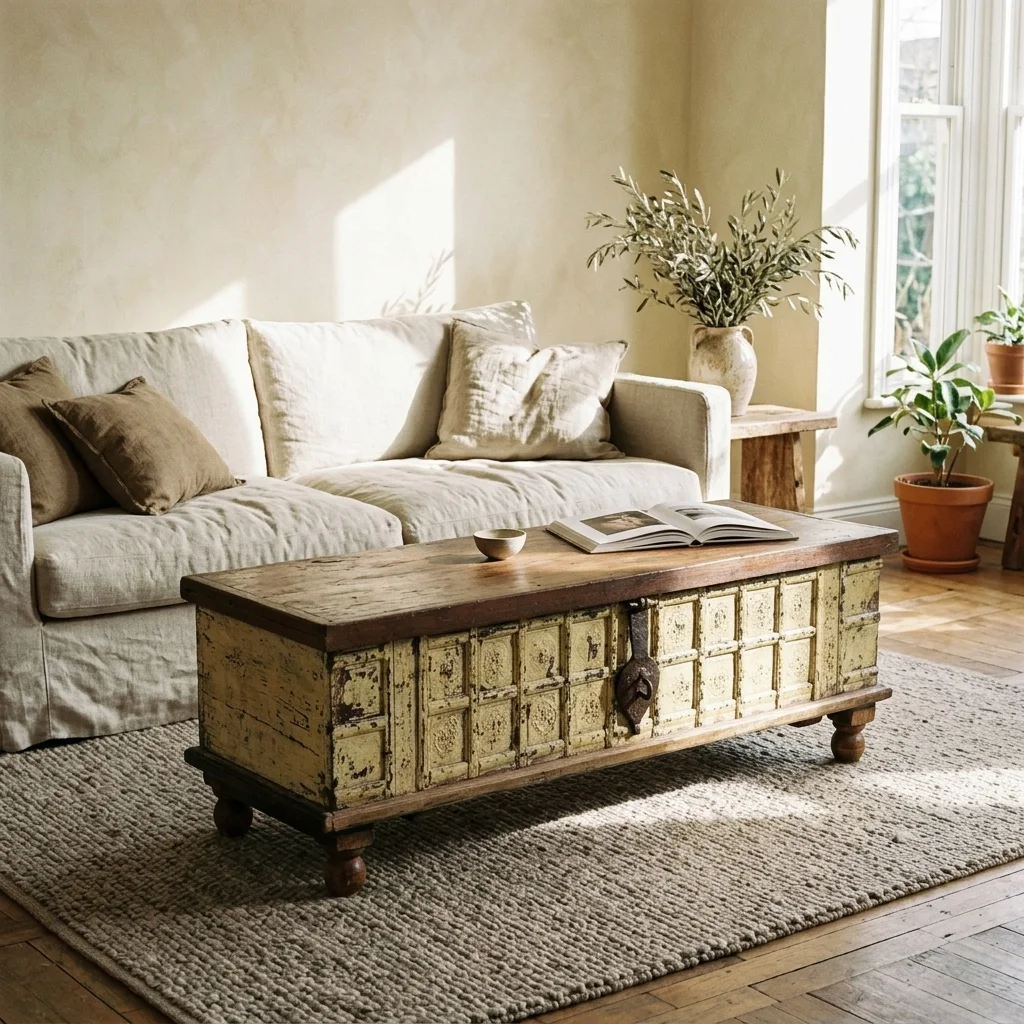
A perennial favorite among interior designers is converting a substantial chest into a low-profile centerpiece. A design like the Antique Chest Coffee Table Rustic Charm works exceptionally well in seating groups configured around deep-seated linen sectionals or tailored leather sofas. Because antique chests typically feature flat, reinforced lids and sturdy block feet, they easily support daily lifestyle functions while concealing clutter like seasonal throws, game boards, and spare cushions inside.
Scale and Clearance Guideline: Ensure the height of your chest coffee table sits within 1 to 2 inches of your sofa cushion height (typically 16 to 18 inches off the finished floor). Maintain a minimum circulation corridor of 16 to 18 inches between the edge of the chest and the sofa frame. This distance allows natural legroom and comfortable passage without requiring you to stretch uncomfortably to set down a cup or book.
While low-slung trunks anchor floor planes, pieces with vertical rise establish eye-level focal points. Incorporating a piece such as the Rustic Chest Of Drawers With Distressed Paint introduces vintage color variations—chalky blues, aged verdigris, or faded ochres—that soften expansive drywall or wallpapered surfaces. In an entryway, this style of chest creates an immediate point of welcome, offering practical catch-all organization for keys and mail while introducing handcrafted warmth at the home's threshold.
When styling tall or mid-height painted chests, contrast is paramount. Set distressed paint finishes against quiet wall tones—such as lime-washed bone, warm taupe, or deep moody charcoal—to let the multi-layered paint degradation and natural wood show-through take center stage without visual competition.
Standard rectangular furniture often fails to make proper use of transitional spaces like stair landings, awkward structural recesses, or fireside corners. Distinctive silhouettes like the Antique Slanted Chest Jodhpur solve this spatial puzzle by introducing an unconventional geometry. The historical slanted lid—originally devised for record-keeping, textile storage, or agricultural bookkeeping—adds an artisanal oddity that draws the eye into quiet nooks. Pair an angled chest beside a tailored reading armchair, dressing the flat ledger section with a directional task light and a stack of art monographs.
For spaces with industrial or minimalist inclinations, integrating a Vintage Iron Storage Chest introduces structural gravitas. The industrial cadence of riveted iron plates, substantial drop handles, and functional hasps serves as an assertive counterpoint to tactile floor coverings like berber rugs or herringbone parquetry.
Styling the surface of a rustic chest requires restraint. Because the wood itself is rich with natural knots, chisel marks, iron studs, and wax patinas, overloading the lid with clutter creates visual chaos. Instead, curate using the principle of tactile counterpoint.
Rustic timber requires softer surrounding materials to achieve home comfort. Pair the rugged surfaces of iron and aged wood with high-touch textiles: slubby Belgian linen drapery, nubby bouclé or shearling accent chairs, and hand-knotted wool or flatweave jute floor coverings. The tension between the smooth, yielding qualities of the textiles and the rigid, historical grain of the timber creates visual depth that makes living spaces feel deeply layered.
When styling the top of a wooden chest or storage coffee table, observe three foundational guidelines:
Artisanal wooden furniture exported to countries like the United States, Canada, the United Kingdom, and across Europe faces vastly different atmospheric conditions than the subcontinent where it was crafted. Modern interior heating and air conditioning significantly alter ambient relative humidity, requiring conscientious care.
Solid hardwoods are hygroscopic; they naturally absorb moisture in humid conditions and release it in dry air. During Northern Hemisphere winters, forced-air central heating can cause indoor relative humidity to drop below 30%. This rapid drying may induce seasonal shrinkage, hairline checking, or slight timber movement along joints. To preserve your piece:
The aged patina on a handcrafted chest is its most valuable visual asset; aggressive modern cleaning chemicals can strip away decades of character in minutes.
Styling a home with character isn't about assembling a showroom catalog; it is about choosing pieces that carry physical presence, human effort, and longevity. A handcrafted rustic chest transforms an ordinary living area into a layered, comforting sanctuary that feels curated over time rather than purchased overnight. Whether deployed as a multi-functional trunk coffee table, a bedroom heirloom, or a quiet statement in an entryway, genuine timber and forged metal bring enduring soul to contemporary living.
Explore our curated collections of architectural salvage, one-of-a-kind antique furnishings, and custom-manufactured hardwood pieces at ArtisansJodhpur, or connect with our design team to source tailored rustic furnishings crafted by master artisans for your next residential or commercial project.