
Shopping Cart

Explore the multi-generational woodworking, blacksmithing, and hand-patination traditions of Jodhpur that transform dense timbers and raw iron into architectural, heirloom-grade home decor.
In the arid landscape of western Rajasthan, where the Thar Desert meets ancient trade routes, Jodhpur has stood for centuries as an epicentre of master craftsmanship. The historic region of Marwar developed a distinct decorative vocabulary born out of necessity, royal patronage, and enduring architectural vernaculars. Here, furniture and decorative accents were never conceived as disposable conveniences. Instead, havelis, desert fortresses, and merchant residences demanded robust joinery, dense indigenous timbers, and protective ironwork engineered to withstand extreme diurnal temperature swings.
Today, this lineage is preserved by hereditary guilds of craftsmen—most notably the Suthar woodworking communities and the Lohar blacksmiths. When an interior designer in London, Sydney, or New York specifies an authentic Jodhpur accent piece, they are not merely purchasing seasoned timber; they are integrating centuries of specialized tool knowledge, relief chiseling, and hand-compounded wax finishes into a modern space. Understanding these four core pillars—architectural woodcarving, blacksmithing, precision inlay, and manual patination—reveals why Marwar decor retains a tactile weight and character impossible to simulate with high-speed automated milling.
The hallmark of genuine Marwari woodwork lies in the depth of its carved relief. In contrast to modern CNC routers that create uniform, flat-bottomed troughs, traditional woodcarving relies on a dynamic interplay of light, undercut shadow, and slight organic variations. A master carver works with an array of hand tools: curved gouges (ramba), V-parting chisels, and lignum-vitae or seasoned rosewood mallets.
Carvers in Jodhpur balance two foundational styles:
These techniques find their ideal canvas in large-format reflective surfaces. For instance, the Tall Wooden Mirror demonstrates how fluted profiles, dentil cornices, and hand-shaped inner borders frame mirror glass, transforming an expansive wall into an architectural statement. When executed in dense, slow-growth timbers like Sheesham (Dalbergia sissoo) or reclaimed Teak, every chisel strike remains crisp for decades without rounding off or feathering.
Wood and iron have enjoyed an inseparable relationship in Jodhpur design since the 15th century. Because Rajasthan’s desert climate swings from freezing winter nights to blistering summer afternoons, timber naturally expands and contracts along its grain. Early Marwar artisans discovered that combining hand-beaten wrought iron with solid hardwood provided mechanical stabilization while offering formidable visual gravity.
Rather than concealing hardware, Rajasthani design elevates it to a focal design element. Artisans forge iron over coal hearths, hammering bar stock into structural corner braces, decorative rosettes, drop-ring pulls, and substantial strap hinges. The hand-hammered texture—known as peening—leaves subtle surface facets that reflect light with an earthy, matte sheen.
Hand-forged iron elements also play an integral role in contemporary residential concepts that lean toward industrial, Wabi-Sabi, or modern farmhouse aesthetics. The bold balance of black metal and pristine glass seen in the Metal Frame With Mirror illustrates how the Lohar blacksmithing tradition strips away fussy ornamentation while retaining the rich, beaten character of raw, patinated iron.
While deep relief carving represents the muscular side of Jodhpur craft, bone inlay represents its meticulous counterpoint. Historically commissioned by royal courts to mimic ivory ornamentation, bone inlay involves hand-sawing camel bone or ethically sourced buffalo horn into delicate tesserae, floral petals, and chevron tiles.
The artisan traces each pattern onto the solid wood substrate, chisels away the timber bed to an exact millimeter depth, and seats each tile before locking them in place with dyed organic resin matrices. Once cured, the surface is hand-scraped and polished using fine sandpaper and oil until the transition between wood, resin, and bone is completely flush. This technique produces dazzling optical depth, offering a luminous focal point in formal living rooms, entry halls, and master suites.
A finely built wooden piece can be entirely ruined by a flat, plasticized polyurethane spray. Authentic Jodhpur heirloom decor relies instead on breathable, layered finishes that celebrate the timber’s natural grain patterns, seasonal shifts, and authentic distressing.
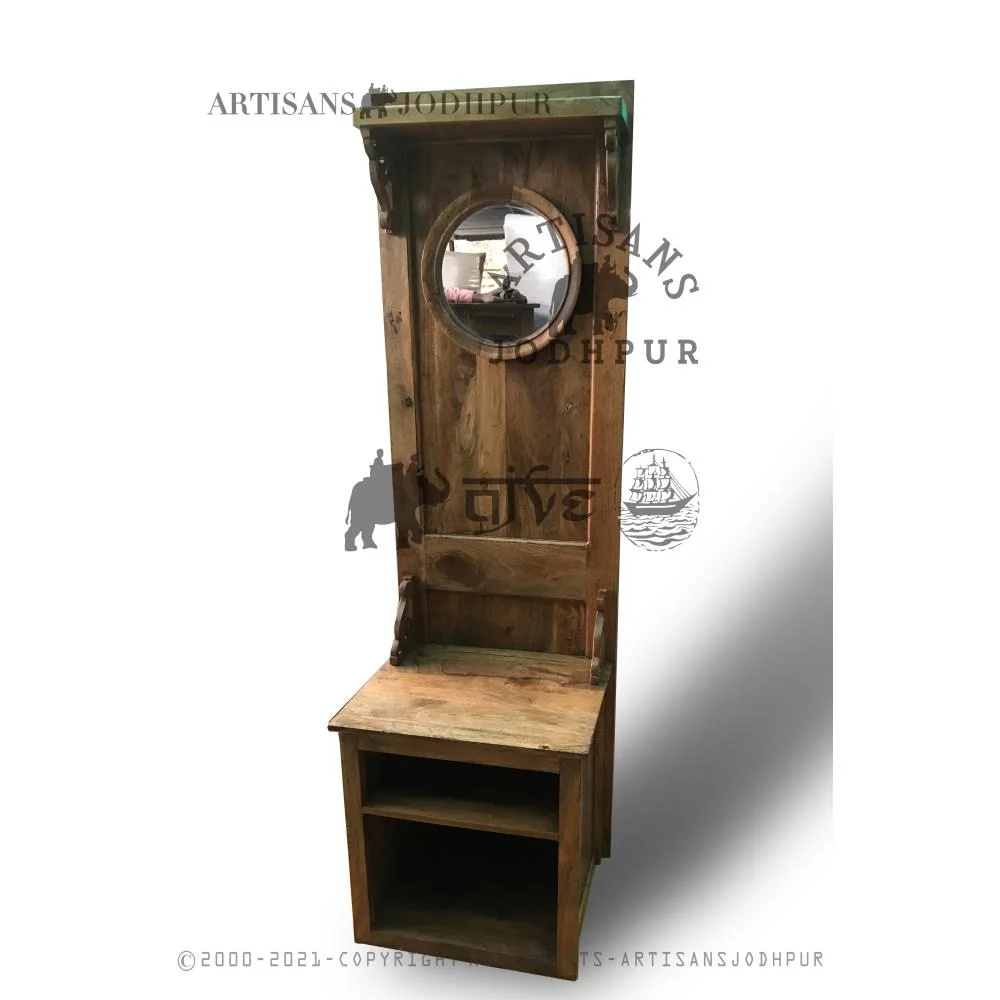
This tactile depth is particularly vital for functional pieces like the Decorative Hall Stand With Mirror, where daily human contact gradually polishes the wax finish, making the furniture more handsome the longer it remains in service.
In contemporary interiors across North America, Europe, and Australia, floor space must balance beauty with utility. Heritage Jodhpur pieces excel in compact or high-traffic areas because their proportions originate from functional haveli storage architecture—where shallow niches, concealed cabinets, and vertical utility were essential.
Rather than hanging a flat mirror above a generic chest, design-conscious homeowners increasingly select integrated architectural cabinetry. The Wooden Mirror Storage Cabinet exemplifies this approach: heavy-set timber rails and traditional peg-and-tenon construction hide functional interior shelving behind a mirrored front. By combining reflective glass with enclosed storage, rooms gain visual dimension without sacrificing practical storage for toiletries, keys, or dining accessories.
Dense hardwoods like Sheesham, Acacia, and reclaimed Teak originate in climates with varying seasonal humidity. When these pieces arrive in climates equipped with dry winter central heating or continuous summer air conditioning, a few basic maintenance steps ensure they endure across generations:
Heirloom decor is defined by the human hands that shaped it. In an era dominated by flat-pack disposable furnishings and uniform synthetic veneers, the hand-chiseled facets, coal-forged ironwork, and hand-rubbed wax patinas of Jodhpur offer irreplaceable warmth, substance, and soul. Whether deployed as a striking entryway anchor or an intricate bathroom vanity mirror, handcrafted Marwari decor connects modern living spaces with one of the world’s richest artisanal traditions.
For interior designers, boutique hoteliers, and homeowners seeking authentic solid-timber statement pieces built to commercial architectural standards, ArtisansJodhpur provides bespoke manufacturing, container shipments, and tailored design collaborations directly from the workshops of Rajasthan.
Browse our handcrafted Jodhpur catalog or message our workshop for exact dimensions, finish photos, and export quotes.

