
Shopping Cart

A deep exploration of reclaimed teak and sheesham timber, examining structural cell stabilization, natural patina formation, seasonal moisture physics, and low-maintenance preservation.
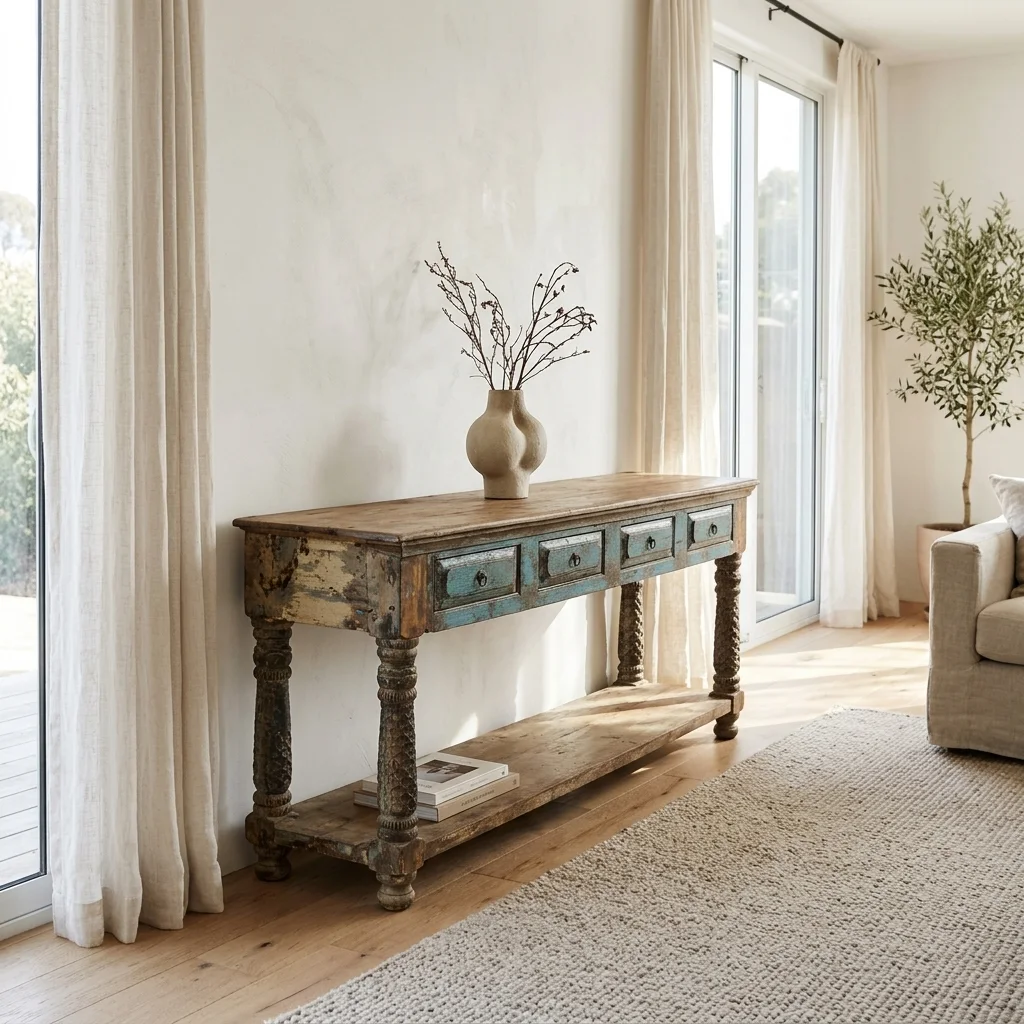
Reclaimed timber occupies a rare space in contemporary interior architecture. Far beyond a nod to sustainable sourcing, architectural salvage from Rajasthan, Gujarat, and central India represents an irreplaceable reservoir of old-growth material. When residential structures, colonial outposts, and rural granaries reach the end of their architectural lifespan, the timbers recovered from them—predominantly Tectona grandis (Teak) and Dalbergia sissoo (Sheesham or Indian Rosewood)—exhibit material properties that modern plantation lumber simply cannot reproduce.
These ancient structural beams, lintels, and architectural doors spent between 60 and 150 years curing in place under intense thermal cycles and natural atmospheric fluctuations. During these decades, free water escaped the cellular matrix, secondary cell walls collapsed and stabilized, and ambient air permanently crystallized internal resin channels. The result is timber with profound biological stability, exceptional density, and an authentic historical surface finish that informs every bespoke silhouette built in our Jodhpur workshops.
Understanding how a reclaimed piece will mature within a modern home begins with knowing the cellular differences between salvaged Teak and Sheesham.
Historically specified for monsoon-exposed exterior portals, ships, and structural pillars, old-growth Indian teak possesses an extraordinarily high natural silica content and dense concentrations of natural oils (specifically tectoquinones). These chemical compounds render the timber naturally resistant to rot, termites, and fungal degradation. In its reclaimed state, teak displays a characteristic golden-amber to deep leather-brown tone, often interrupted by charcoal-grey oxidation where old iron joinery or iron spikes once sat. The grain is generally straight to undulating, with a waxy, silky tactile finish that self-lubricates over time, requiring very little topical intervention.
Known across the design world as Indian Rosewood, Sheesham is celebrated for its dense, interlocked grain and pronounced contrast between deep chestnut heartwood and lighter, amber sapwood. With a Janka hardness rating typically exceeding 1,600 lbf—significantly harder than European white oak or American black walnut—salvaged sheesham possesses structural muscle. Decades of service cure the timber's natural gum pockets, resulting in a glass-smooth surface when hand-planed. In an heirloom piece such as our Reclaimed Wood Sideboard Colorful Panels, sheesham provides the structural rigidity necessary to house dimensional salvaged door panels while framing shifting architectural textures.
True patina is not a surface glaze; it is a permanent molecular and physical modification of the wood's exterior layers. Understanding this distinction prevents homeowners and designers from accidentally stripping decades of character during maintenance.
When salvaged timber is exposed to sunlight over generations, ultraviolet radiation breaks down surface lignin—the complex organic polymer that binds cellulose fibers. The cellulose oxidizes into a soft, silvery-grey or golden-parchment tone. Concurrently, human touch, seasonal monsoon humidity, and cooking soot in heritage havelis impart minute amounts of fatty acids and natural mineral deposits into the open grain pores.
Furthermore, many structural elements salvaged across Marwar were traditionally coated in multi-layered, lime-based distemper paints, indigo washes, or verdigris mineral pigments. As these architectural components weathered, the pigment bonded directly with the drying cellular structure. When our master artisans clean, calibrate, and carefully hand-rub these timbers, they preserve this chronological stratification. A piece like the Reclaimed Wood Console, Turquoise Drawers celebrates this interplay: beneath the curated brush of weathered turquoise lies decades of dense, oxidized timber that artificial distressing methods can never credibly replicate.
One of the most persistent misconceptions in interior design is that reclaimed wood is completely inert. Wood is inherently hygroscopic; its cellular structure continually absorbs and releases water vapor to maintain Equilibrium Moisture Content (EMC) with its surrounding environment.
However, salvaged timber behaves with fundamentally greater predictability than green, kiln-dried plantation timber. Over decades of service, the capillary pathways that once moved moisture through the living tree become partially occluded by hardened sap, crystalline resins, and microscopic calcification. Consequently, while reclaimed teak and sheesham still react to ambient humidity shifts, their tangential and radial expansion coefficients are reduced by up to 40 to 60 percent compared to newly harvested timber.
In modern homes throughout North America, the UK, Europe, and Australia, winter heating and summer air conditioning create dramatic indoor climate swings:
For large continuous surfaces—such as the slab tops found on the Reclaimed Wood Dining Table With Blue Accents—solid wood engineering must anticipate this micro-movement. Our craftsmen employ traditional mortise-and-tenon framing, slotted mounting brackets, and floating cleat joinery. These structural methods allow the reclaimed top to breathe laterally without splitting the frame or shearing mechanical fasteners.
The greatest danger to reclaimed hardwoods is over-maintenance using incorrect synthetic sealers. Polyurethane varnishes, aggressive lacquers, and aerosol furniture polishes containing silicone create synthetic surface films that suffocate the wood, trap moisture unevenly, and irreversibly obscure the tactile patina.
Instead, follow this conservation-grade, low-maintenance protocol designed to let salvaged hardwoods flourish indefinitely.
Day-to-day cleaning requires nothing more than a dry, lint-free microfiber cloth or an electrostatic feather duster. The undulating surface of weathered reclaimed timber features micro-ridges and original adze marks that capture ambient dust. Run your cloth along the direction of the grain rather than across it. Avoid saturated cleaning rags; if a spill occurs, blot it immediately with a clean, barely damp cotton towel, followed by an immediate pass with a bone-dry cloth.
The single most effective care strategy requires no creams or tools: simply monitor your interior climate. Maintaining an indoor Relative Humidity between 40% and 55% safeguards solid timber, delicate veneers, and structural joinery. In regions with freezing, dry winters (such as the Northern United States, Canada, and Northern Europe), using an evaporative humidifier prevents seasonal checking and hairline surface fissures.
Reclaimed teak and sheesham rarely require chemical conditioning. Once or twice a year, nourish the timber using a high-grade paste wax formulated from pure yellow beeswax and carnauba wax suspended in pure mineral spirits.
The rich grain and historic color variations of reclaimed Indian hardwoods introduce an irreplaceable organic tension to contemporary spaces. In clean-lined Scandinavian, Warm Minimalist, or Industrial lofts, excessive high-gloss or synthetic furnishings can read as sterile. An architectural statement piece—whether an expansive reclaimed tabletop anchoring a minimalist dining room or a patinated multi-drawer storage piece in an open-concept living zone—grounds the eye through historical depth.
To curate these surfaces successfully:
Reclaimed teak and sheesham furniture is never merely static decor; it is an enduring, evolving collaboration between nature, historic carpentry, and thoughtful modern living. By understanding the structural resilience born from decades of natural curing, respecting seasonal atmospheric physics, and employing gentle, wax-based preservation, you safeguard a piece of architectural heritage that grows more compelling with every passing decade.
Whether you are specifying custom furniture for an international hospitality project or sourcing an heirloom focal point for a residential sanctuary, our craft studio in Jodhpur works directly with interior designers, architects, and discerning homeowners worldwide. Explore our catalog of architectural salvage and bespoke reclaimed collections, or get in touch with our design team to request a personalized quotation for custom-dimensioned pieces.
Browse our handcrafted Jodhpur catalog or message our workshop for exact dimensions, finish photos, and export quotes.

