
Shopping Cart

Discover the science behind reclaimed teak and sheesham patina, how salvaged timber behaves across global climates, and the master artisan methods for preserving heritage wood furniture.
In modern furniture design, few materials convey the tactile gravity and historic narrative of reclaimed architectural timber. When architects and interior designers source antique wood, they are rarely just looking for an aged surface; they are seeking a biological and structural stability that fresh plantation-grown lumber simply cannot replicate. In the workshops of Jodhpur, Rajasthan, our artisans primarily salvage two legendary hardwood species from century-old structures: Indian Teak (Tectona grandis) and Sheesham (Dalbergia sissoo, often classified as North Indian Rosewood).
These timbers began their life as structural elements—load-bearing columns, floor joists, ceiling rafters, and monumental lintels—salvaged from historic havelis, colonial civic buildings, and vernacular dwellings slated for renovation. Over seventy to one hundred and twenty years, this wood underwent natural, slow-cycle atmospheric curing. The internal cellular water (both capillary and bound moisture) that causes green timber to warp and cup has long since departed, leaving behind a dense, petrified lignified matrix.
Yet, reclaimed wood remains an active organic substance. Understanding how reclaimed teak and sheesham develop their characteristic patinas, how they interact with modern HVAC systems in Western interiors, and how to maintain them without stripping their hard-won character is essential for curators, trade buyers, and homeowners alike.
The term "patina" is frequently reduced to a synonym for surface wear, but in reclaimed timber, it is a complex physical and chemical record of age, light exposure, and micro-environment.
Old-growth teak contains exceptionally high concentrations of natural resins, tectoquinones, and natural silica. When exposed to ambient air and ultraviolet spectrums over decades, these internal extractives oxidize. Fresh teak often exhibits an uneven, blotchy yellowish-green hue; reclaimed teak, by contrast, settles into a deep, radiant golden-honey tone, or weathers into an ethereal, muted silver-ash when left unfinished in external elements. The grain feels buttery yet dense, cool to the touch due to surface silica, and naturally repels surface-level spills far better than lower-density softwoods.
Sheesham is renowned for its wild, interlocking grain and striking tonal contrasts between pale sapwood and dramatic, deep-auburn heartwood. When sheesham matures across decades of service, the cellular tannin deposits within the heartwood deepen into rich tones of roasted chestnut, espresso, and violet-tinged brown. Unlike contemporary kiln-dried sheesham, which can sometimes appear sharply banded or reddish-orange, reclaimed sheesham possesses a softened, burnished depth. Light refracts through the undulating wood fibers, creating a subtle chatoyancy—a natural cat's-eye shimmer—under directional interior lighting.
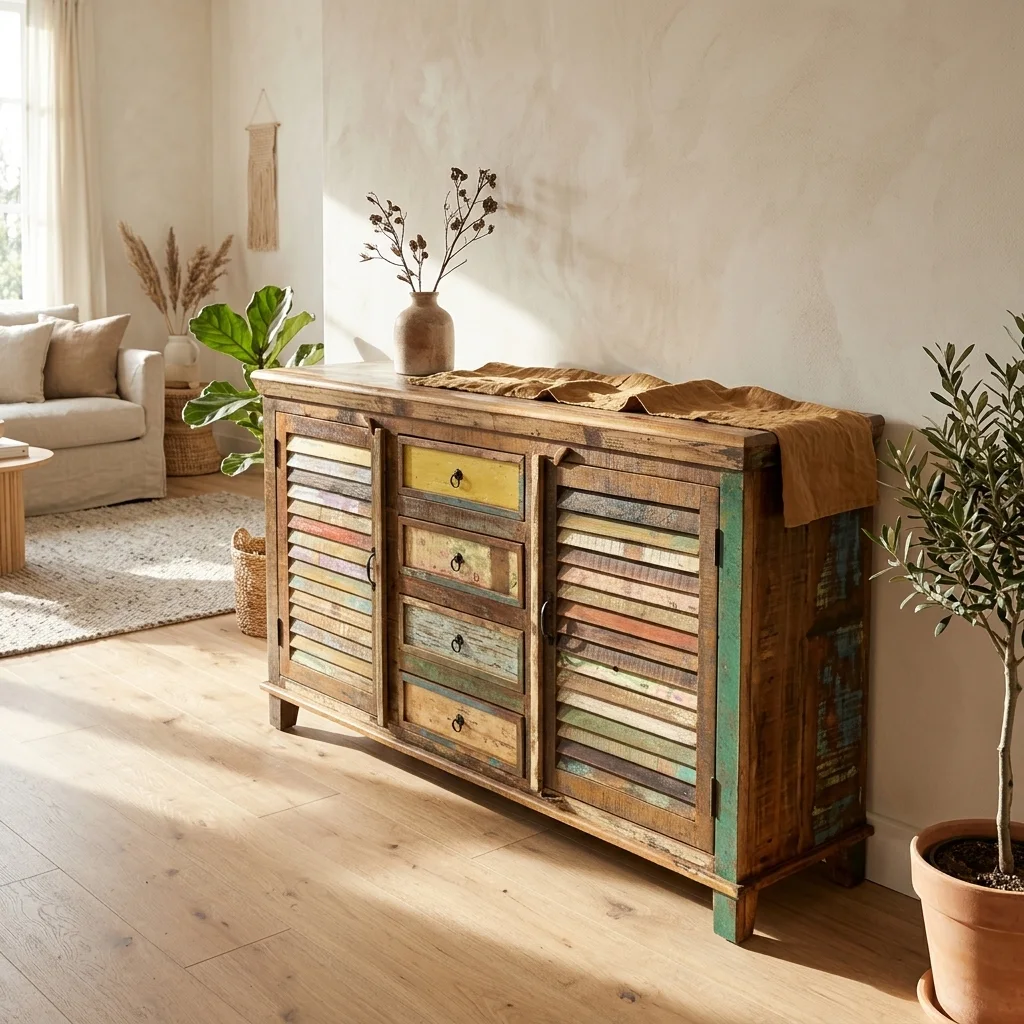
In many Marwar architectural salvage elements, the wood is interwoven with physical human history. Layers of natural mineral pigments, lime washes, and early casein (milk) paints were applied across generations to exterior doors and interior storage elements. Rather than stripping these surfaces down to raw timber, master woodworkers meticulously consolidate the historic pigment layers with hand-buffed wax coats, as seen in the Vintage Reclaimed Wood Sideboard In Multicolor. In these statement case goods, the patina is not just wood oxidation; it is a layered visual stratigraphy of regional color palettes spanning indigo, terracotta, ochre, and bleached chalk.
A common misconception among furniture buyers is that because reclaimed timber is aged, it has permanently ceased moving. In physics and material science, wood is inherently hygroscopic: its moisture content continuously fluctuates to achieve Equilibrium Moisture Content (EMC) with the surrounding air's temperature and Relative Humidity (RH).
Consider the logistical journey of a handcrafted dining piece or cabinet: it is framed and joined in Jodhpur, where the climate is semi-arid, with ambient relative humidity frequently dipping below 25% during hot and dry winter months, climbing briefly during the monsoon. When that piece is shipped to an apartment in Chicago, a townhouse in London, or a waterside home in Sydney, it enters an entirely new atmospheric reality.
Because reclaimed timber has undergone decades of cell-wall compression and moisture cycles, its movement is significantly reduced—often by as much as 50% compared to fresh, kiln-dried plantation timber. However, that remaining movement must be respected through intelligent joinery.
Quality artisanal furniture never fights seasonal movement; it accommodates it. When crafting a large surface like the Rustic Reclaimed Wood Round Table, seasoned craftsmen avoid rigid gluing or mechanical cross-pinning across broad expanses. Instead, they employ structural techniques refined over centuries:
When high-mass reclaimed wood furniture arrives in a new home or hospitality interior, an initial acclimatization period ensures the piece integrates without sudden thermal shock.
Allow newly unboxed reclaimed furniture to rest in its intended room for 14 to 21 days before subjecting it to heavy load or dramatic thermal swings. Avoid unpacking a shipment in a freezing garage and immediately carrying it into a heated 22°C (72°F) living room; sudden localized surface heating while the core remains cold and moisture-laden can trigger hairline surface checks.
Reclaimed timber does not require an aggressive regimen of synthetic polishes. In fact, many mass-market furniture sprays do measurable harm to historic patinas.
Never apply aerosol polishes containing silicone oils, dimethicone, or synthetic hydrocarbons to reclaimed wood. Silicone creates an impenetrable, plasticky barrier that clogs the open grain, attracts airborne particulate matter, and prevents future applications of natural restorative oils or waxes. Similarly, steer clear of aggressive household degreasers, multi-surface sprays containing ammonia, or acidic citrus solutions that degrade historic milk paint layers and strip natural timber oils.
For routine cleaning, simplicity is paramount:
Once or twice a year, especially before the onset of the winter dry season, conditioning the timber replenishes surface moisture barriers and maintains the subtle, deep luster of the wood.
For glass-door architectural pieces like the Reclaimed Wood Display Cabinet, spray glass cleaner directly onto your cleaning rag rather than misting toward the glass panes; overspray can pool along the interior reclaimed wooden muntins and leave pale water rings.
Part of the design distinction of specifying reclaimed timber is recognizing the difference between structural failure and authentic material expression.
A micro-check is a shallow, longitudinal hairline fissure (typically less than 1 mm wide and a few inches long) that naturally occurs along the medullary rays of hardwood as surface fibers expand and contract. In reclaimed wood, micro-checks are structurally inert; they relieve microscopic internal stresses without compromising joint strength or planar integrity. They should be celebrated as authentic signatures of timber history, not filled with synthetic wood putty.
By contrast, a structural split is a dynamic, gaping crack that runs completely through the board's thickness, destabilizing structural joinery. In handcrafted production, ArtisansJodhpur prevents structural failures through proper material selection, internal floating brackets, and precision butterfly key (Dutchman) joinery, where carved hardwood bowties physically lock intersecting fissures.
Incorporating reclaimed teak and sheesham into contemporary interior projects provides an irreplaceable anchor of warmth against cool architectural materials: raw concrete, lime plasters, cold-rolled steel, and clean sheet glazing. Because each plank carries its own timber density, old fastener marks, hand-planed irregularities, and individual growth ring spacing, no two completed pieces share identical aesthetics.
For architectural firms, interior designers, and bespoke collectors, ArtisansJodhpur coordinates every step of the reclamation, stabilization, and crafting process in Rajasthan. From verifying structural moisture levels to applying traditional wax polishes that honor the wood's century-long journey, our atelier ensures that every handcrafted statement piece arrives ready to enrich residential and commercial spaces for generations to come. Inquire with our design team to discuss custom sizing, finishes, or trade catalog specifications.
Browse our handcrafted Jodhpur catalog or message our workshop for exact dimensions, finish photos, and export quotes.

